

ONE MOTO Europe
Building the
largest sustainable delivery fleet
across Europe.
ONE MOTO pitch deck for a debt / equity raise.
Backing the infrastructure behind Europe’s delivery sector,
where the current model is asset-heavy, combustion-reliant
and increasingly out of step with city rules and operator economics.
Confidential.
Shared with intended recipients only,
on the basis they are considering investment into ONE MOTO Europe.
HEADLINE TRACTION
What we have in hand
Signed contracts
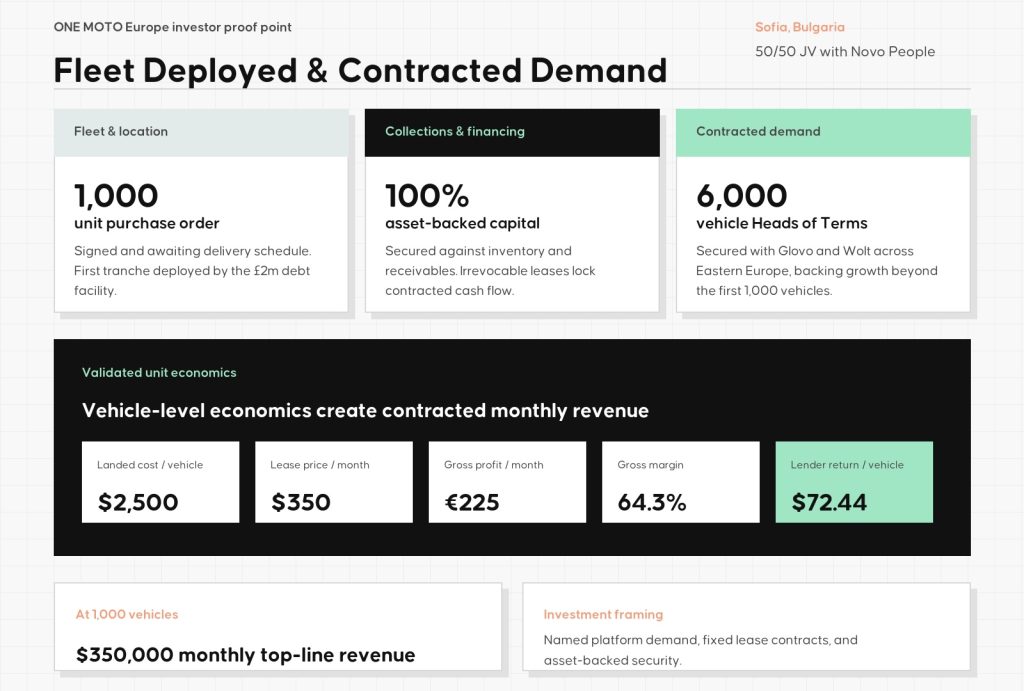
1,000 vehicles
Purchase order signed and awaiting delivery schedule.
6,000 vehicle Heads of Terms
Secured with Glovo and Wolt in 10 countries across Eastern Europe.
100%
asset backed
Deployed capital backed, secured against inventory & receivables.
Execution, margin & asset-backed scale.
Landed cost of $2,500 per vehicle against a lease rate of $350 per vehicle per month on an irrevocable three year term
Opportunity
A financeable fleet model for electrified urban logistics
ONE MOTO Europe leases electric delivery vehicles to last-mile operators on fixed three-year contracts, removing CapEx friction for customers while creating contracted, recurring revenue against tangible fleet assets.
Regulatory pull
European cities are moving logistics fleets toward zero-emission access, with low-emission-zone rules and corporate disclosure regimes reshaping delivery procurement.
Operator pain
Platforms need vehicles, servicing, replacement batteries, telemetry and local support without tying up cash in ownership.
Why now
The EV mobility sector has moved past the “is this a good idea” stage. Investors are no longer backing a concept, they are backing execution, and ONE MOTO Europe already has fleet on the road, rent coming in, and contracts behind the next 6,000 vehicles.
ONE MOTO answer
The winner of the last-mile fleet providers are the ones who have a complete ecosystem, focused on the long-game.
Leasing is not new, but owning the entire supply and value chain is.
If you need a moat, this is it.
ONE WORLD consists of:
ONE Fleet
ONE Charge
ONE App
ONE Distribution
ONE Care
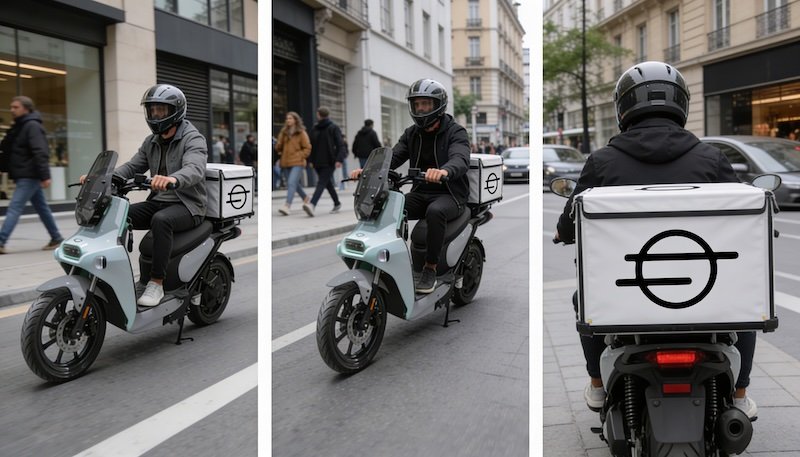
THE PROBLEM
- Last mile delivery operators need vehicles to fulfil contracts, but tying up capital in ownership is inefficient and inflexible for businesses whose volumes swing with demand.
- Combustion vehicles are costly to run, prone to downtime, and increasingly locked out of city centres. Over 300 European cities now run Low Emission Zones restricting older combustion vehicles, and the rules are tightening further in 2026, including new bans on Euro 2 petrol and Euro 5 diesel vehicles in Brussels from January 2026, expanding Zona a Bajas Emisiones coverage across Spanish cities of over 50,000 people, and a move to electric-only Class 3 zones in Stockholm.
- Combustion EV ownership solves the emissions problem but creates a capital problem. High upfront cost and residual value risk put fleet electrification out of reach for smaller and mid-sized delivery operators.
- This is the gap ONE MOTO Europe sits inside: leasing removes the capital burden while giving operators compliant, modern vehicles on a predictable monthly cost.
- There is also a compliance driver behind the demand. Under the EU’s Corporate Sustainability Reporting Directive (CSRD), large and listed companies operating in the EU must report audited environmental, social and governance data, including emissions and climate transition plans, with mandatory external assurance of what they report (Salesforce, PwC). For delivery platforms and their retail customers, fleet electrification is becoming a reporting obligation, not a nice-to-have.
THE SOLUTION
- ONE MOTO Europe leases electric delivery vehicles to operators on fixed, all-in monthly terms, so the customer gets a compliant, modern EV without the capital outlay or the resale risk.
- Leasing suits this customer base because delivery businesses scale up and down with demand and would rather pay a predictable monthly cost than carry a depreciating asset on the balance sheet. It is the same logic a small business owner applies when they lease a van instead of buying one outright, they want the vehicle working for them, not sitting as a liability.
- The lease includes the vehicle, maintenance and support, so operators avoid unplanned downtime and repair bills.
- Electric, because city access rules and operator running costs are moving that way regardless of what any individual company decides. Last mile, because two-wheelers and light commercial EVs are the vehicle types best suited to short urban routes, frequent stops and tight margins. Now, because the contracts, the vehicles and the operating history already exist. This is not a plan to build a model, it is a model already running.
Proof of Phase One: Results
The Ask, Restated
As you read through the opportunity we’d like you to keep in mind the ask, and consider the returns available. The investment landscape has evolved, and so we work accordingly. The need remains unchanged. We can accommodate debt, equity and a combination. We do not want to dilute too soon, however, we realise the value of the capital required to get us to achieve our targets. This is a conversation to have in person.
- £2m debt: funds 1,000 vehicles against a signed purchase order, 100% asset-backed, on three year irrevocable leases generating $350,000 in monthly revenue at deployment.
- £10m debt/equity: funds 4,000 further vehicles of growth capital plus founder liquidity, at an implied entry valuation of $15,625,000, moving the fleet toward the 20,000 vehicle milestone that triggers Series B.
- In return: a secured position in a leasing business with proven unit economics, contracted demand for the next 6,000 vehicles, and a clear, milestone-based path through Series B to a targeted 2031 IPO.